Stop Using Training to Fix What Design Broke.
November 11, 2025
By Nick Combs, CSP
Retraining is one of the most common ways leaders avoid a harder truth.
It feels responsible. It sounds supportive. It gives the organization something visible to do.
It is also frequently the wrong first move.
Training matters. New people need it. Changed processes need it. Critical tasks need reinforcement. Standards need to be taught clearly and repeated consistently.
But training is not a repair strategy for bad design.
When an incident repeats, when a quality miss keeps resurfacing, or when operators rely on workarounds to get through the shift, leaders often default to the same response: retrain the team.
Sometimes that helps.
A lot of times it hides the real failure.
If the job is poorly designed, no amount of retraining will make it stable. If the cycle time is unrealistic, the layout is awkward, the tool is unreliable, the handoff is weak, the standard is hard to follow, or the competing priorities are obvious, people will keep adapting. They have to. The system is asking them to choose between formal compliance and getting the work done.
That is not a training gap.
That is a leadership gap.
Consider how often this happens in plants. A jam clearance step requires awkward reach and poor visibility. A sanitation task is scheduled into an impossible window. A forklift route crosses pedestrian traffic because the flow was never truly separated. A changeover depends on tribal knowledge instead of visual standards. A permit process exists, but everyone knows production pressure can quietly override it.
Then something goes wrong.
The response is a toolbox talk.
That is too small.
Before a leader assigns training as the solution, a few questions should come first. Was the standard clear in the field, not just on paper? Was the task physically set up to be performed that way? Did the operator have the time, tools, and authority to follow the standard? Were there conflicting incentives pushing the wrong behavior? Did supervision reinforce the rule when the schedule got tight? Could the team pause the work without punishment?
Those questions matter because people usually follow the system they actually live in, not the one leadership thinks exists.
That is why repeated retraining can quietly damage trust. Operators see the mismatch. They know when the real issue is staffing, layout, access, equipment condition, changeover time, or mixed signals from leadership. When management keeps sending them back to class instead of fixing the work, the message becomes clear: we are going to explain the problem to you instead of solving it with you.
That rarely improves performance for long.
A better sequence is simple. First, observe the job where it happens. Second, identify what the work is asking people to overcome. Third, change the conditions that make the wrong action easier than the right one. Then train to the improved standard.
That order matters.
Good training stabilizes a well-designed process. It does not rescue a broken one.
Plant leaders should remember this: the goal is not just informed people. The goal is reliable execution. Those are not the same thing. A highly informed operator inside a poorly designed system will still be forced to adapt. And repeated adaptation is where risk, drift, and fatigue start to grow.
Training has a place.
A very important place.
But when it becomes the automatic answer, it usually means leadership is choosing the most comfortable intervention instead of the most effective one.
Do not ask people to memorize their way around weak design.
Fix the work.
Then teach the standard that the work can actually support.
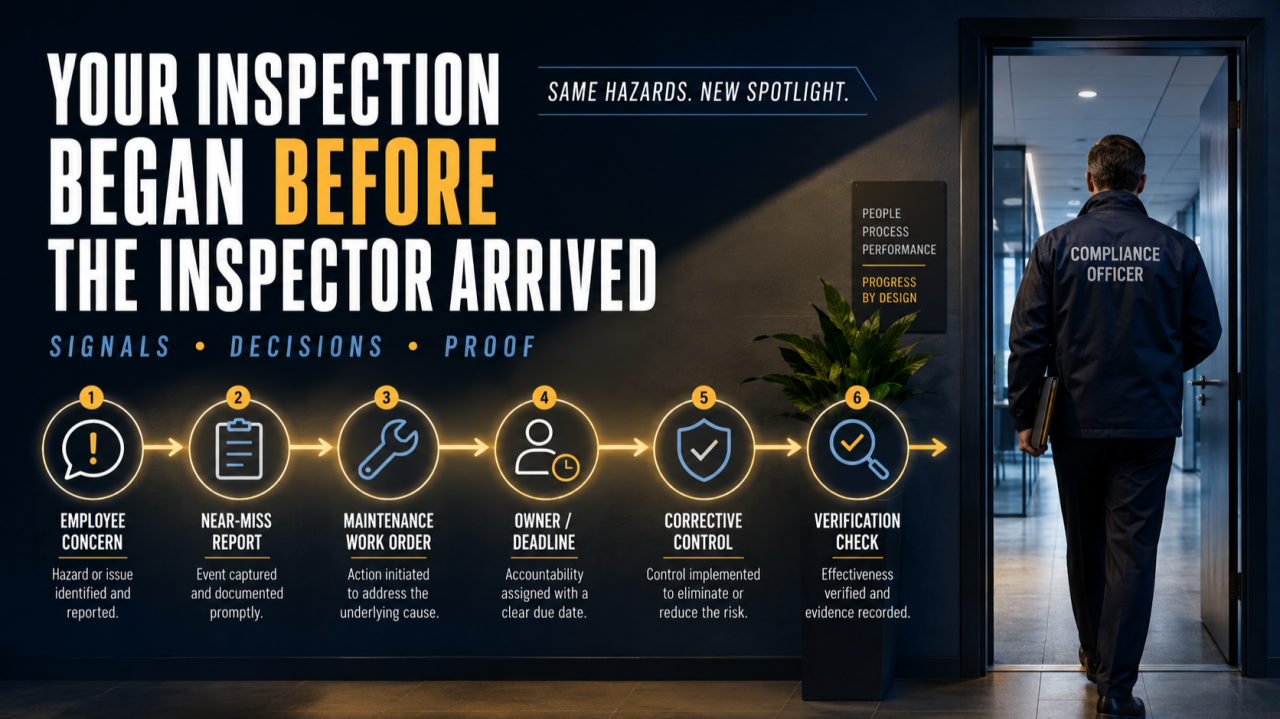
No Action Is Complete Without Proof.
January 8, 2026
By Nick Combs, CSP
Plants do not usually drift because nobody cares.
They drift because closure gets too easy.
Somebody says the issue was handled. A supervisor says the conversation happened. A manager says the team has it. Engineering says the change is in motion. Safety says training was completed. Maintenance says the repair is done.
Maybe all of that is true.
Maybe none of it is.
Without proof, leadership is not tracking progress. It is tracking optimism.
That matters more than most teams realize.
A lot of plant work lives in the gap between decision and verification. Guarding gets approved but the condition is not photographed. A procedural change gets discussed but the document never changes. Training gets delivered but there is no roster, no observation, and no evidence that the job was actually performed to standard. A corrective action gets marked closed because the pressure moved on.
Then the same issue returns.
Not because people lied.
Because the organization accepted intention as completion.
That is expensive.
Proof does not have to be complicated. It just has to be real. A revised SOP. A signed-off work order. A photo of the repaired condition. A completed training roster. A field verification. A PM revision in the system. A documented permit change. A supervisor observation that shows the new standard is actually being used.
That is closure.
Everything else is conversation.
Some leaders resist this because they think it creates bureaucracy. In reality, it removes noise. Teams waste enormous time re-litigating old issues when nobody can tell what was actually done. They repeat meetings. They repeat arguments. They repeat promises. Proof shortens all of that. It gives the organization memory.
It also sharpens accountability.
When every action has one owner, one due date, and one clear closure standard, performance becomes easier to see. Leaders can distinguish between slow progress and no progress. They can tell the difference between a blocked item and a neglected one. They can escalate early instead of getting surprised late.
That is not administrative discipline for its own sake.
That is operational control.
Plant leaders should be especially careful with recurring actions tied to safety, quality, and reliability. Those are the easiest places for verbal closure to create false confidence. If a conveyor guard was modified, show it. If a lockout step changed, show it. If a near miss led to a new control, show it. If a contractor requirement was tightened, show it.
The standard should be simple: if someone new walked into the area tomorrow, could they see the change or verify it without needing a long explanation?
If not, the action probably is not closed.
This also changes the quality of meetings. Weekly reviews get shorter when teams stop speaking in generalities. “We’re working on it” is not an update. “The new interlock was installed Tuesday, tested Wednesday, and operator signoff is attached” is an update. One creates motion. The other creates confidence.
Plants do not improve from agreement alone.
They improve from evidence.
So the next time an action comes back marked complete, ask one more question.
What is the proof?
That question will clean up more drift than another speech ever will.
Calm Is Not Complacency. It Is Control.
February 19, 2026
By Nick Combs, CSP
Some plants look strong because they move fast under pressure.
That is not strength.
That is adaptation.
There is a difference.
A plant that survives on heroics can look impressive from a distance. Supervisors are everywhere. Maintenance is improvising. Production is pushing. Good people are carrying the day again. The line stays moving. Orders still ship. Everyone goes home tired and convinced they won.
But repeated heroics are usually evidence that the system is unstable.
Real control is quieter than that.
A controlled plant does not need constant rescue. Standards are visible. Work is sequenced well. Handoffs make sense. Risk is known before the task begins. Operators do not have to guess. Supervisors do not have to translate expectations in real time. Problems get seen early, when they are still small enough to fix without drama.
That kind of calm makes some leaders uncomfortable.
Calm does not look urgent. It does not create the same emotional signal as a last-minute recovery. It does not give people a stage to prove how committed they are. It just produces repeatable work.
And that is exactly why it matters.
When leaders reward the save more than the stable process, the organization learns the wrong lesson. It starts to admire exhaustion. It starts to normalize confusion. It starts to believe that struggling hard is the same thing as running well.
It is not.
A plant leader should pay close attention to where heroics show up most often. Look at the changeover that only works when your best operator is present. Look at the startup that always feels messy. Look at the area where the same housekeeping issue reappears. Look at the near miss that has been “talked about” three times but still lives in the work. Those are not people problems first. Those are design signals.
That is where leadership should go to work.
Walk the process and ask better questions. What part of this job depends on memory instead of standard work? Where does the handoff get weak? What gets rushed when the schedule tightens? What do your best people do silently that the system has never captured? What friction are you asking operators to absorb every shift because it has become normal?
That is practical leadership.
Not louder direction. Better design.
In most plants, instability hides inside familiar routines. A tagout that takes too long. A permit process nobody trusts. An inspection route that gets skipped when staffing is tight. A material flow issue that forces unnecessary motion. A startup checklist that exists on paper but not in practice. Small things. Repeated things. Expensive things.
A calm plant is not one with fewer expectations. It is one with fewer surprises.
It still has urgency. It still has standards. It still has accountability. But it does not ask people to create control from scratch every day. The system carries more of the load.
That is the point.
Plant leaders do not need to make work look intense. They need to make work hold under pressure. They need processes that survive fatigue, turnover, shift changes, visitor pressure, and production demand. They need teams that can pause early instead of recover late.
Calm is not passive.
Calm is disciplined.
Calm is a leadership decision.
And in a plant, it is one of the clearest signs that control is real.
The Silent Killers: Why Confined-Space Work Demands Our Urgent Attention
Confined-space work remains one of the most dangerous activities in general industry. Despite decades of awareness and regulation, workers continue to lose their lives in preventable tragedies. Recent incidents and research emphasize the critical need for improved compliance, training, and cultural accountability in confined-space safety.
On May 7, 2025, a maintenance worker in Palm Desert, California, fell approximately 20 feet into an underground vault. Emergency crews responding to the scene reported the presence of hydrogen sulfide gas, an extremely hazardous atmospheric condition. Despite their efforts, the worker was pronounced dead at the scene (KESQ News Channel 3, 2025). This is not an isolated case but one of many similar incidents occurring across the United States each year.
In September 2023, a contractor working inside a water tank near Oklahoma City succumbed to asphyxiation. OSHA’s investigation revealed that the employer failed to conduct atmospheric testing and lacked a permit-required confined space (PRCS) program, resulting in citations totaling over $103,000 (U.S. Department of Labor, 2023). These failures are consistent with broader patterns seen across industries.
Purdue University’s Agricultural Confined Space Incident Database (2024) documented 51 confined-space incidents in 2023, including 22 fatalities. Notably, Indiana alone accounted for five incidents, and most cases involved grain bin entries, which are especially hazardous due to engulfment and oxygen-deficient environments. The data underscores the pressing need for training and oversight, particularly in the agricultural sector.
Statistical analysis shows that 56% of confined-space fatalities are attributed to hazardous atmospheres, 20% to mechanical hazards, and 11% to engulfment (National Institute for Occupational Safety and Health [NIOSH], 2020). Furthermore, nearly two-thirds of confined-space fatalities involve would-be rescuers who attempt entry without proper training or equipment (Centers for Disease Control and Prevention [CDC], 2017).
Despite OSHA’s PRCS standard (29 CFR 1910.146), many organizations fail to implement comprehensive entry procedures. OSHA estimates that only about 30% of workers involved in confined-space work receive annual training, though enhanced training could reduce fatalities by up to 85% (OSHA, 2023).
To reverse this trend, employers and safety leaders must prioritize:
Strict adherence to PRCS requirements, including entry permits and atmospheric testing.
Regular, comprehensive training for all personnel involved in confined-space operations.
Availability of non-entry rescue equipment and trained standby personnel.
A cultural shift that places safety above productivity.
Confined spaces—such as tanks, silos, vaults, and pits—should not be death traps. The continued occurrence of preventable fatalities is a moral failure as much as it is a regulatory one. The lives lost in Palm Desert and Oklahoma City must not be in vain. These incidents must serve as a call to action for employers, regulators, and the broader public to treat confined-space safety with the urgency it demands.
References
Centers for Disease Control and Prevention. (2017). Fatal occupational injuries involving confined spaces. https://www.cdc.gov/niosh/topics/confinedspace/
KESQ News Channel 3. (2025, May 7). Worker dies after falling into underground vault in Palm Desert. https://kesq.com/news/2025/05/07/worker-dies-underground-vault
National Institute for Occupational Safety and Health. (2020). Preventing deaths and injuries of workers in confined spaces. https://www.cdc.gov/niosh/docs/86-110/
Occupational Safety and Health Administration. (2023). Confined spaces standard: 29 CFR 1910.146. https://www.osha.gov/confined-spaces
Purdue University. (2024). Summary of U.S. agricultural confined space-related injuries and fatalities 2023. https://engineering.purdue.edu/ABE/Research/Surveys/GrainBinEntrapment
U.S. Department of Labor. (2023, October). Oklahoma tank death results in citations for confined space violations. https://www.osha.gov/news/newsreleases
Confined-space work remains one of the most dangerous activities in general industry. Despite decades of awareness and regulation, workers continue to lose their lives in preventable tragedies. Recent incidents and research emphasize the critical need for improved compliance, training, and cultural accountability in confined-space safety.
On May 7, 2025, a maintenance worker in Palm Desert, California, fell approximately 20 feet into an underground vault. Emergency crews responding to the scene reported the presence of hydrogen sulfide gas, an extremely hazardous atmospheric condition. Despite their efforts, the worker was pronounced dead at the scene (KESQ News Channel 3, 2025). This is not an isolated case but one of many similar incidents occurring across the United States each year.
In September 2023, a contractor working inside a water tank near Oklahoma City succumbed to asphyxiation. OSHA’s investigation revealed that the employer failed to conduct atmospheric testing and lacked a permit-required confined space (PRCS) program, resulting in citations totaling over $103,000 (U.S. Department of Labor, 2023). These failures are consistent with broader patterns seen across industries.
Purdue University’s Agricultural Confined Space Incident Database (2024) documented 51 confined-space incidents in 2023, including 22 fatalities. Notably, Indiana alone accounted for five incidents, and most cases involved grain bin entries, which are especially hazardous due to engulfment and oxygen-deficient environments. The data underscores the pressing need for training and oversight, particularly in the agricultural sector.
Statistical analysis shows that 56% of confined-space fatalities are attributed to hazardous atmospheres, 20% to mechanical hazards, and 11% to engulfment (National Institute for Occupational Safety and Health [NIOSH], 2020). Furthermore, nearly two-thirds of confined-space fatalities involve would-be rescuers who attempt entry without proper training or equipment (Centers for Disease Control and Prevention [CDC], 2017).
Despite OSHA’s PRCS standard (29 CFR 1910.146), many organizations fail to implement comprehensive entry procedures. OSHA estimates that only about 30% of workers involved in confined-space work receive annual training, though enhanced training could reduce fatalities by up to 85% (OSHA, 2023).
To reverse this trend, employers and safety leaders must prioritize:
Strict adherence to PRCS requirements, including entry permits and atmospheric testing.
Regular, comprehensive training for all personnel involved in confined-space operations.
Availability of non-entry rescue equipment and trained standby personnel.
A cultural shift that places safety above productivity.
Confined spaces—such as tanks, silos, vaults, and pits—should not be death traps. The continued occurrence of preventable fatalities is a moral failure as much as it is a regulatory one. The lives lost in Palm Desert and Oklahoma City must not be in vain. These incidents must serve as a call to action for employers, regulators, and the broader public to treat confined-space safety with the urgency it demands.
References
Centers for Disease Control and Prevention. (2017). Fatal occupational injuries involving confined spaces. https://www.cdc.gov/niosh/topics/confinedspace/
KESQ News Channel 3. (2025, May 7). Worker dies after falling into underground vault in Palm Desert. https://kesq.com/news/2025/05/07/worker-dies-underground-vault
National Institute for Occupational Safety and Health. (2020). Preventing deaths and injuries of workers in confined spaces. https://www.cdc.gov/niosh/docs/86-110/
Occupational Safety and Health Administration. (2023). Confined spaces standard: 29 CFR 1910.146. https://www.osha.gov/confined-spaces
Purdue University. (2024). Summary of U.S. agricultural confined space-related injuries and fatalities 2023. https://engineering.purdue.edu/ABE/Research/Surveys/GrainBinEntrapment
U.S. Department of Labor. (2023, October). Oklahoma tank death results in citations for confined space violations. https://www.osha.gov/news/newsreleases